Prideful Ownership
The term “Pride and Ownership” isn’t new to the fire service. Hopefully, most ELAFF readers are familiar with it and understand its importance to successful company operations. Chief Rick Lasky runs the most comprehensive program on “P&O”, with a lecture program, a book, a blog, and an internet webcast show. These are all great programs, and you can find more info on them by clicking here. Recently, Rhett Fleitz (The Fire Critic) attended one of Chief Lasky’s seminars, and was spurred to write his own blog series on the topic (link to all posts here). He did a great job of explaining “P&O” as he understands it, and I decided to take the time to write a quick post from my point of view. Maybe other sites will join in and compile a number of posts on the subject, as they did with “Brotherhood”.
I’m going to try to make this one short and sweet. I know that we’ve gained a lot of new followers recently, and they may not be accustomed to my occasional “novel-length” posts, as Captain Chaos would say. I’ll simply break down those two words and their meaning to me.
PRIDE
Pride is a fickle beast. It can obviously be a great tool for company development, or Chief Lasky wouldn’t talk about it, but it can also be the downfall of an individual’s career. It should be noted that we are not really talking about “individual pride” here. Individual pride, or pride in oneself, is fine in limited amounts, but it can be toxic if over-applied. Too much individual pride will eventually cause us to put ourselves ahead of everything else. Ahead of our Brothers. Ahead of our company. Ahead of the civilians we serve. This can be seriously detrimental to the firehouse atmosphere. Be proud of your accomplishments, but never let that pride lead you to abandon your Brothers. So, what type of pride are we looking for?
The pride which “P&O” refers to is bigger than the individual level. We are talking about “company pride”, “departmental pride”, and “fire service pride”. We need to have pride in the bigger picture. If we have pride in our company, then we will be willing to go the extra mile to improve our company (or department). What if your company is the slow, outlying runt of the department? Perfect! What if your department is small, underfunded, and poorly motivated? Perfect! You have the perfect opportunity to display the effects of company pride. Start by leading the example yourself. Take some extra time to do some short drills/P.T., clean and fix up forgotten tools or repair a worn and broken area in the firehouse (every ‘house older than 1 year has SOMETHING broken). If you are a full-timer, do this after normal work hours, while the others are watching t.v. If you are a volunteer, do it on a night when there is no regular training and you aren’t assigned to a duty shift. You may be alone at first. You may attract remarks questioning the purpose of your actions. Hopefully, others will eventually join in. Once you build “company pride”, it becomes a nearly unstoppable force. Each shift wants to contribute more than the others, each company wants to work harder than their neighbor, each department wants to be the best, and we ALL want to make the fire service function better and more efficiently.
Jason Jefferies at Working the Job posted THIS article, which includes an email from a retiring Charlotte (NC) fireman. What is one of the things that stands out to me in this post? He doesn’t just refer to himself as “a fireman”, he repeatedly calls himself a “Charlotte fireman”. He doesn’t just hold pride in our profession; he has pride in his department. Officers and senior firemen, this is for you. Company pride is the key to your crews working harder, training more, and ENJOYING the job at YOUR department. Make sure that your crews aren’t simply “proud to be firefighters”. They should be “proud to be (insert your dept. here) firefighters”. This is huge for retention problems in both the paid AND vollie worlds. If your members are simply “firefighters”, they will have no problem leaving for another department if morale gets bleak in your ‘house. However, if they are proud to be “(insert dept. name) firefighters”, they will be hard pressed to leave under any circumstance. Chiefs and administrators, let your personnel build pride in their department. If they see a need for improving a piece of front-line equipment, let them do it. They know when something isn’t working, they use that equipment…you don’t. Their lives depend on the proper function of that equipment…yours doesn’t. Let them make the department their own. If they want to build tables and other firehouse items, encourage it. If they decide to start an impromptu drill, *GASP*, WITHOUT an officer…let them roll with it. Stop the micro-management, it stunts department growth, quells company pride, and buries morale in a grave of dissolved motivation.
OWNERSHIP
“Ownership” picks up where the “pride” leaves off. Once there is a fair amount of company pride developed, we begin to OWN our company. This means taking everything that happens to the company “to heart”. If something happens to the company, it happens to you. If a tool is dirty or broken, it is YOUR fault because that is YOUR tool. This doesn’t mean that those tools don’t belong to your Brothers, they should feel the same. If something isn’t right, you fix it. Take things personally. Don’t just be a member/employee of your department, make that department YOUR OWN. If every member makes that personal commitment to the company, there will be a dramatic improvement around the ‘house. This all goes back to “company pride”.
With that, I’ll end this post. Feel free to leave a comment, and don’t forget to “share” this post using the buttons below.
We have some big news coming up in the next month or so. Stay tuned and stay safe, “leather-freaks”.
Lt. Lemon
Share:

Fear
“Courage is resistance to fear, mastery of fear—not absence of fear.” – Mark Twain
The above quote is one of meaning to those in our profession, as it is to all who put themselves in harm’s way for the sake of others. We call ourselves “the bravest”, evoking the image of courageous lads riding steam engines to extinguish blazes, as our predecessors once did. We plaster our “fearlessness” on our cars, helmets, and t-shirts. We advertise it to the world. Was this the case with those men over 100 years ago? Did they call themselves “brave”, or did their actions cause the public to bestow that title upon them? Were they more concerned with simply “doing the job”, rather than getting the glory? I’d like to believe so, but can we say the same for ourselves today?
For the most part, yes. There is still a large group of the fire service working for the right reasons. Those who remember that WE are here for THEM, the civilians, the public whom we SERVE. Those who remember that THEY are expecting us to rescue them. THEY are expecting us to put out the fire. THEY expect us to GO INSIDE. THEY expect us to be ready. Those with the right mindset ARE ready, but the right mindset does not require one to be fearless. In fact, the “fearless” mindset is as foolish as the “no entry” mindset.
It is time to correct the tired, old “We fight what you fear” cliché. The proper saying should be, “We fight what you fear, but we fear it, too.” Yes, firefighters FEAR fire, and why shouldn’t we? It is a fearsome element. Fire kills, has killed, and will continue to kill…and THAT is exactly why we must master OUR fear and continue to ENTER BUILDINGS for interior attack and search. As long as there is a chance of a life hazard, we owe it to the citizens, whom we SERVE, to make the interior attack and search. That is our JOB. Any random citizen can stand in the front yard and spray water through a window, Statter911.com provides a plethora of videos demonstrating this. The “green line jockeys” have even begun to gather “helmet-cam” style point-of-view footage. Imagine if your municipality began distributing 1 3/4″ lines to strategic hydrant locations in your response area. Teams of citizens could replace many “yard attack” departments. However, those average citizens likely will not go inside. That is the benefit that a good department brings to the table. We don’t just put the fire out and save the foundation. We come in to look for you, even if we don’t have a report of an occupant. We go in to put the fire out, and stop the damage before things burn to the ground. Obviously, there is some risk management to be considered and, at times, a defensive operation is required, but I don’t believe it should go nearly as far as some would like. But, back to the fear.
As I stated, we FEAR fire. If you’ve never felt a little twinge of fear as you make the push towards the fire room, then you: A) have never made an interior attack, B)are clinically insane, or C) just didn’t recognize it AS fear. You see, though firefighters and civilians both fear fire, there is a difference between the nature of our fears.
Normal, sane civilians fear fire in the most natural way. Fear through panic. They see fire or smoke, recognize the threat to their life, and react instinctively. Their brains shut down into the most primitive state. Their sole function becomes staying alive. Most flee for safety. This is good. It means less work for us, and most importantly…survivors, if they manage to escape the structure. If they don’t escape, we know that they will be near windows, behind doorways, or headed down hallways towards egress points. Others will simply hide, their brains conflicted to the point of freezing. This is also useful, as it gives us an idea of where a victim might hide. Under beds, in closets, in bathtubs. Knowing how possible victims might react can be invaluable to us, and there are many resources where you can read more on this subject. The fear-through-panic mindset is most evident in multiple occupant situations. We rarely hear of family members finding each other BEFORE exiting the structure. Part of this is because WE teach them to exit first. The other reasoning behind this may be that, in a fury of self-preservation, they completely forget about the other residents. They focus on getting out, and only upon exiting do they remember, as their brains restart, that there were others inside. Perhaps this is why we see more incidents where occupants re-entered to make a rescue, rather than finding the other victim in the first place. Or, perhaps they simply follow the escape plan and hope that everyone else does the same. Maybe it is a bit of both.
Firefighters, on the other hand, cannot afford to panic. We are trained early on to face our fear, master it, and use it to master the fire. We have a fear through respect. We know the destructive power of fire. We’ve seen it since the academy. Because of this knowledge, we train harder. We learn the behavior of fire and we study the effects of applying water to it. We learn how to defeat it, and to find those who cannot. We train on it…over, and over, and over…while we weed out those who will not. We master our fear…and master our ability to defeat its cause. This is why we feel excited when we conquer the beast, because we have, in turn, conquered our fear. It isn’t that we aren’t scared of the beast, it’s that we recognize and respect what will happen if we don’t overcome our fear and do our job. We know what will happen if we don’t make the search efficiently. We realize the outcome of not aggressively extinguishing the blaze.
We are not aggressive out of fearlessness and insanity. We simply realize that we serve a purpose greater than “saving the foundation”. We owe it to the public to perform to our full potential. It is what THEY expect…and what WE should deliver.
– Lt. Lemon
Share:
Product Review: Westsider Front Holder
I know it’s been a while, and I hate to disappoint you, but this is not a revolutionary, inflammatory rant on the slackers of the fire service. This is a simple, benign, and unbiased product review. Before I delve into this new territory for ELAFF, I’d like to post a quick disclaimer on our reviews. The products we review are sent to us, free of charge, by the manufacturer. We may, or may not, be allowed to keep these products after the review is published. We will be as open as possible about the circumstances of each review, but rest assured that we will receive NO compensation for anything written about a product…other than possibly keeping the sample. We will be open and honest about our opinions of the product, be they positive or negative. That’s the short-hand version of it, so on with the review.

Retail Price – $29.99
Info from the owner – “Homemade Diamond plate shield\front holder. I made these holders to fit Cairns New Yorker, Sam Houston. 1000, 1010 and 1044. I have not drilled the holes in the side to attach to the helmet so they will fit all helmets listed. These holders have been Laser Cut and bent professionally . They are cut from .063 plate of aluminum diamond plate.”
Review
The Westsider Front Holder is a replacement for the eagle/beaver/solid piece of easily bent metal which holds the leather front/shield on a traditional helmet. They are made by Jonathan Nixon, a firefighter with the Charlotte, NC Fire Department. As stated above, the front is made of aluminum diamond plate. There seems to be a huge number of “diamond plate fans” in the fire service, just as there are leather-freaks. I, for one, am not one of those fans. I simply don’t like flashy “bling” on my helmet, however this review isn’t about my cosmetic preferences, so I showed the front around ELAFF HQ. There were plenty of “oohs” and “ahhs”, and “how do I get one” was asked multiple times. I took this as a sign that firefighters would want one of these on their helmet and began the mounting process. The front comes without pre-drilled holes, so it can be easily mounted on most traditional helmets. It is DESIGNED to be mounted on a Cairns N5A, N6A, 1000, 1010, or 1044. I was planning on being rough with my sample, so I mounted it on an old Ben Franklin I (that’s the good model, not the new Ben II Plus thermo-plastic one). This helmet was a little shorter than the front holder was designed for, and the leather front was a bit tall, but I managed to get the Westsider secured.

I wore it through on all runs, including a few fires. It also had plenty of drill time, along with a few training fires. It held up just fine, as I would hope.
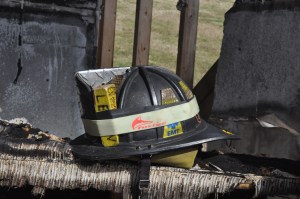
For the final test, I used the remains of a sprinkler demonstration rig. I decided to punch a few holes in some drywall and bang on the wall studs a few times. Honestly, I wouldn’t expect anyone to punch through a wall using their helmet unless they ABSOLUTELY had to…we carry tools for those tasks. However, I hadn’t yet inflicted any real damage to the Westsider, so I thought I’d give this a try.

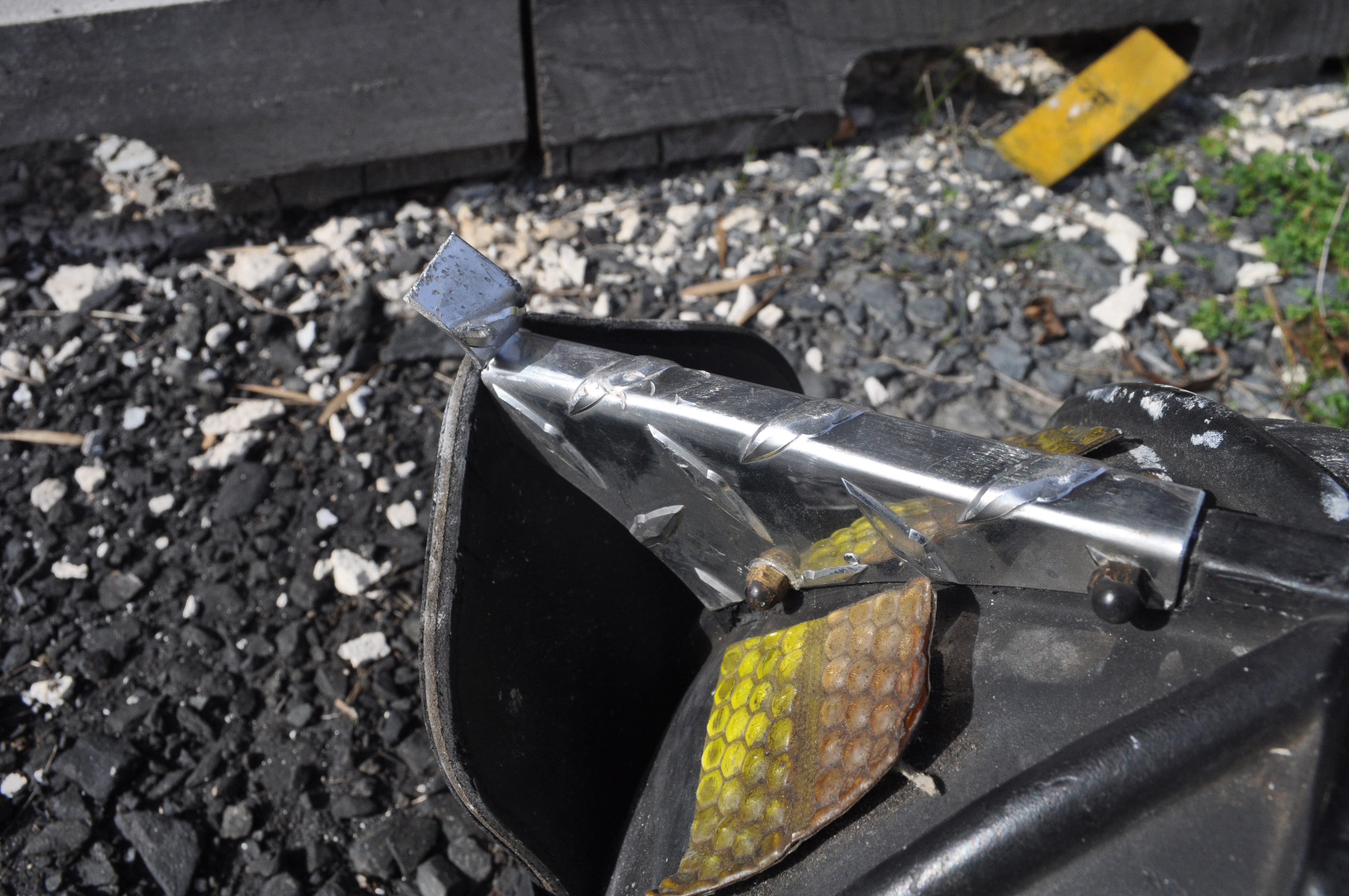
The drywall didn’t faze it, but pounding on the studs caused the front flap to lift up. I attribute this to the aforementioned under-sized helmet/over-sized shield issue. If I had been using a smaller shield, or a Cairns helmet, I do NOT believe this would have happened. As for the rest of the Westsider, it didn’t have a dent on it. If you DO manage to dent or deform one of these, you’ll probably want to look at replacing the entire helmet…not just the Westsider. This definitely held up better than the stock front holder, which was bent beyond recognition when I removed it.
With the trial phase complete, I was left with one last idea. Getting rid of that shine. It was easily covered with a liberal coating of “NFPA compliant”, black “rattle-can” paint. You could just as easily use any other color.

There you have it. Whether you are a fan of shiny things, or not, the Westsider Front Holder is a viable option for replacing the worn-out, factory holder on your helmet. The diamond plate is strong and looks great, and can be customized easily to match your style. Maybe Jonathan will even start putting out his own colored versions.
You can find out more, and purchase the Westsider Helmet Front, on their Facebook page.
You may also email Jonathan directly at: jrn1cb5a@email.cpcc.edu
– Lt. Lemon
Share:

A Trip to See the King
This weekend, Captain Chaos joined me on an expedition. We were invited down to Roanoke, Virginia to visit the King of Blogs himself, Captain Willie Wines Jr. We loaded up the ELAFF-mobile and hit the road to Roanoke. Captain Wines was kind enough to set us up with a place to stay at a local family’s home. I never met his parents, but the kid who lived there was a huge fan of Willie’s…I think his name was Rhett-something. Apparently, he likes to ride his bike down to Willie’s station to hang out with the firemen, plus he’s a follower of our blog, as well. When he heard that Lt. Lemon and Cpt. Chaos would be in town, he begged his folks to let us spend the night. Rhett tagged along with us as we stopped by the Fallen Firefighter’s Memorial and were given an exclusive tour of Roanoke’s Historic Firehouse #1.
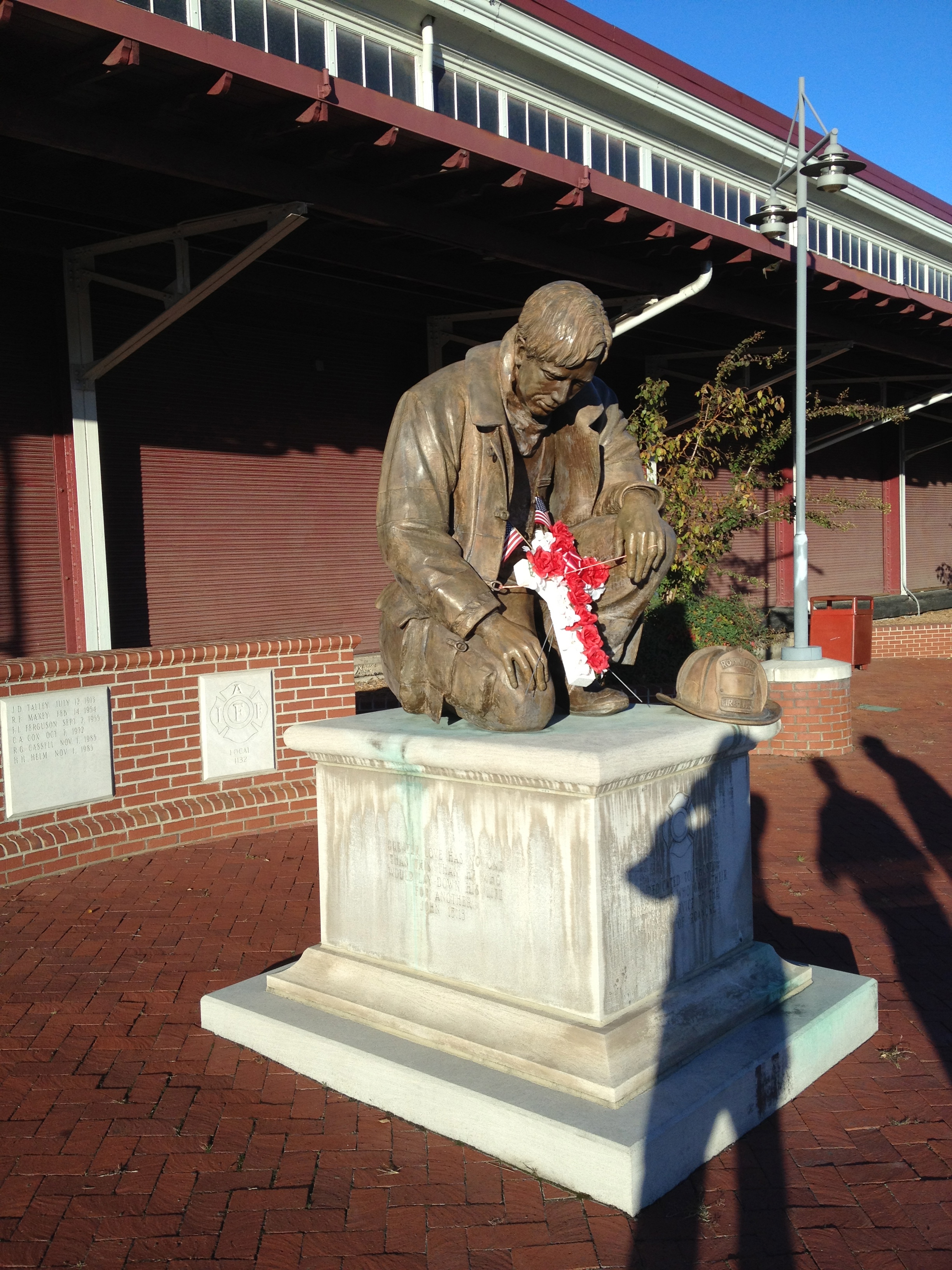

As Chaos and I marveled at the rich history in that house, Rhett spent the time constantly following Willie around and talking about something called the “Fire Critic” and telling us about “deals”. Frankly, I had no idea what he was referring to.
Meanwhile, as the kid kept talking, I remained silent, soaking in the wealth of knowledge shared by Captain Wines about everything from Roanoke Fire history, to general firefighting, to blogging and web design. I may be anonymous, but I will say that Captain Wines has much more experience than me, and I was taught early on to stay quiet and listen when good advice is offered from the senior men. After supper, we returned to Rhett’s house, where Rhett rambled on about “Va Fire News” and how much he loves Dave Statter. I think the only person Rhett admires more than Captain Wines is Statter. He could name every recent post on Statter911.com and he had an enormous Statter911 logo on his bedroom wall. It was sort of strange…
The following day, Chaos and I headed to Station 13 for a ride-along with Captain Wines and his crew. They greeted us with a feast of a breakfast, followed by a tour of the beautiful scenery in the surrounding area. We brought the ride-along curse with us, only catching one run…a medical. Still, we enjoyed the day, as the firefighters of Roanoke are extremely friendly and hospitable. Even as Chaos and I barged in on a Sunday, we never felt un-welcome. Rhett rode his bike down to the firehouse, bringing some BBQ for supper. I’m not sure where his Mom bought it, but it wasn’t too bad. After supper, Chaos and I decided to finally get out of their hair and head back to HQ. We handed off a couple of Lemon Wedges, snapped some photos, and rode off…better for making the trip.
Thanks again to Willie and Rhett.
Next time I’ll bring my voice with me…and maybe my face, too.

-Lt. Lemon
Share:

Tear Down That Wall
It is time for another inflammatory article, boys and girls. Put on your grown-up pants, sit down, and (as always) read the whole post…then comment away. I was recently struck by a random fit of inspiration. I believe it may have started as I recalled the video of Brian Brush’s motivational speech to a group of recruits. I was mulling over what I would say to motivate the new group of recruits on my volunteer department. I couldn’t be as tough with them, after all…they’re just volunteers. I stopped myself short. My mind had begun to wander, as it often does, and an unfortunately common phrase had slipped past my mental firewall, “Just a volunteer.” That brought about some reflection on two terms which are typically used with conflicting meanings. Career and volunteer. The fire service enjoys separating everything into these groups. Career, volunteer, or sometimes a combination. Both sides have their reasons for supporting this practice. I’m here to tell you that it’s wrong. It’s time to tear down that wall.
Let’s first discuss the term volunteer. True “volunteer” departments are completely unpaid. They receive no compensation for the work that they do. Some departments take pride in being “100% volunteer”, and why shouldn’t they? It takes a lot of time and dedication to do this job while still holding down one which pays the bills. Does that make them better than paid members? Nope. It’s simply a neat tradition…a device to raise morale. There are also departments who claim to be volunteer, but they provide small, compensatory payment per call, or man-hour, or class. So in reality, they are paid departments and their members may call themselves paid firefighters. Yet, they are still volunteers. As a matter of fact, I can’t find any historical data depicting a mandatory draft by an American fire department in the last 150 years. Even during the great conflagrations in Chicago and San Francisco, nobody was dragging young men down the street and forcing them to pass buckets of water. Therefore, every fire department in the United States is a volunteer department. It doesn’t matter if you make $0/year or $50,000/year. You voluntarily submitted an application to your department. You are a volunteer…and you should take pride in that. End of story.
Now, what about the “career” folks. That term is often used synonymously with “professional”. Some volunteers dislike this practice because not all “career” firefighters act like professionals, and most “volunteers” do. This may be true, but the rules of English overrule. By definition, a professional is someone who earns a living by doing a specialized trade. Even though most volunteers act professionally, they are not, by definition, professionals…unless they can earn a living making $5/call. The term “career” is a different story entirely.
Full-timers also tend to call themselves “career” firefighters. They use it as a term reserved for those who are “professionals”, as defined above. This immediately brings to mind two officers on my volunteer department. Neither of them has ever held a full-time position as a firefighter. One has put in around 30 years of service, the other around 20 years. They are at every training event possible, and are usually the first to jump into a drill, bringing the new guys with them and teaching as they go. They are officers, and no matter how long those classes take, I’ve never heard them complain in front of their subordinates. They run more calls than many of the younger members. I’ve seen them outwork the 20 year-olds, over and over. I’ve witnessed them run 7 calls between midnight and 4am, only to show up at the local diner at 5am for a cup of coffee and plate of breakfast before heading to their day job. I’d like to see someone look those men in the eyes and tell them that they aren’t career firemen. They’ve skipped countless anniversary dinners, missed many a birthday party, and left far too early on many Christmas mornings. Tell their wives and kids that they aren’t career firemen. They are dedicated to a career in the fire service, regardless of how much money they make while working it…and that sums it up. Being a career firefighter isn’t about the amount of your wages, it’s about the level of your commitment.
There are full-time firefighters who forget about the job when they leave the firehouse. They aren’t dedicated, they aren’t career firemen. There are volunteer firefighters who treat the job the same way. They aren’t career firemen, either. I mentioned a phrase earlier, and it ties back in here. I have heard it uttered by volunteer firefighters. “I can’t take that many classes, I’m just a volunteer. I can’t run that many calls, I’m just a volunteer. You can’t expect that much out of us, we’re just volunteers.” It’s time to remove that facade. It is nothing but a veiled excuse, a cop-out. If you start to think this way as a volunteer, try replacing that phrase with something more honest. “I can’t take that many classes, I’m just not dedicated. I can’t run that many calls, I’m just not dedicated. You can’t expect that much out of us, we’re just not dedicated.” Perhaps that will re-align your focus. Maybe it will be the motivation you need. If you still don’t get it, then quit. The same goes for the full-timers who carry the same attitude. If you can’t get excited about this awesome job, if you can’t get motivated and back on track, if you can’t remember why you chose this path to begin with, or if you chose it for the paycheck, t-shirt, or attention…then quit. If you can’t motivate yourself to truly give your all, then you aren’t needed. You’ll continue spiraling into an abyss of self-hero-worship and false promises…and one day those promises will get someone killed.
From now on, don’t let it be career vs. volunteer, make it the dedicated vs. the posers. Your paycheck, or lack thereof, makes no difference. You can be dedicated to a career in the fire service, dedicated to the job, dedicated to your Brothers, regardless of how much cash it pays you in return.
Paid and unpaid Brothers, unite.
Get the posers motivated, or out of the fire service.
Tear down that wall.
-Lt. Lemon
Share:
The Brotherhood is a Lie
That’s right. The title is referring to the Fire Service Brotherhood. Before you amass a posse and begin an assault on ELAFF HQ, I ask that you read this post to the last word. After that, please share your opinions…positive or negative.
I’ve been working on this post for a few months now. Until recently, it was merely a set of scattered ideas, floating around in my mind without a central focus to tether them all together. This week, I found my focus. A group of firefighters in Georgia uploaded a video to Youtube, showing an outrageous “rookie prank” which they carried out.
Here is the video:
My immediate thought after viewing this video was,”Wow…these guys are crazy!”
I planned on leaving it at that, with no further comment. As usual, I continued to follow the chatter on Statter911. I enjoy observing the varying opinions of Statter’s readers, and their reactions towards one another. The comments began to follow two, distinct paths.
The overwhelming majority of comments voiced disgust and disapproval. Those are the comments I agree with. The small number of opposing comments accosted the dissenters with accusations of overreaction and over-sensitivity.
I fail to see the supposed “innocence” of this “prank”. Ask any ELAFF Local and they will tell you that I am a supporter of firehouse fun and harmless tom-foolery. This prank, however, crossed the line. It may have caused mental trauma to the recipient, and even more likely, it could have resulted in serious injury or death. Don’t believe it? I’ll explain…
What if an off-duty member, carrying a legal and permitted concealed weapon, stopped by the station for a visit? How about a local law enforcement officer seeking a cup of coffee and some small talk. The city that this department protects has seen an increase in violent crime in recent years. If an armed firefighter or law officer entered the station to find his comrades being forced to the floor by a masked gunman, they would most likely react quickly. If they had entered the room as the firecrackers exploded, sounding like gunfire and adding to the realism of the mock execution, I’m sure they would have reacted aggressively. The ironic tragedy of a mock gunman being shot by an uninformed hero would have changed the tone of those supportive comments, and silenced any laughter.
Now, back to the Brotherhood and the focus of this post. There was one comment that veered to the extreme end of the supportive spectrum. It immediately struck a nerve and spurred me to tie those scattered ideas into a solid post. Here it is verbatim:
“You guys are such negative nancy’s. What happened to the brotherhood in the fire department? You are all too busy trying to throw them under the bus. What happened to innocent until proven guilty? As far as the prank being dangerous? I hate to tell you but F.D. Doesn’t mean fire department, but rather freaking dangerous.”
What happened to brotherhood? It doesn’t exist…it is a lie. At least, the “brotherhood” of which this comment speaks is a lie. It seems to be increasingly common for newer members of the fire service to EXPECT the brotherhood. They believe that as soon as they get some bunker gear, they are a solid link in the chain of fire service brethren…and that this link can never be severed. Nope. Sorry, it doesn’t work that way. The TRUE brotherhood between firefighters must be earned, and to keep it, you must stay true to the profession. You can get your issued t-shirt, or pager, or union decal for your truck…but that doesn’t make you a Brother. Don’t get me wrong. Senior firefighters should be there for the rookies. They should answer their questions, mentor them, even give them a little razzing when they get too cocky. Don’t shun the new guys, but make sure they know that they still have something to prove before they fully become a Brother.
Earning a place in the Brotherhood doesn’t require a working fire and an act of heroism, either. I recall a firehouse visit by a German fireman(feuerwehrmann). He spoke little English and had never stepped foot in our house before. We began to tour the station and apparatus; through broken English, hand signals, and my very basic understanding of German (thanks to my German roots) we began to communicate. His “detailed” questions about hose lays, pump rate, equipment, and tactics shone brightly through the language barrier. This was a Brother. He knew firefighting. He lived it. He didn’t leave it behind like a businessman on vacation. He didn’t ask lame questions about flashing lights and sirens. With less than 50 actual, spoken words…he EARNED my trust…and proved his status as a Brother. I assume that by gladly sharing our house and rigs, and by answering his questions with enthusiasm, pride, and knowledge…we earned HIS trust, as well.
Being a member of the Brotherhood goes beyond joining the department and wearing a t-shirt. It is more complex than simply wearing a pager and has no correlation to the amount of lights on your P.O.V. Being a member of the Brotherhood is about looking out for your Brothers. Putting them, and the civilians you protect, before yourself…and not just on the fireground. Being a Brother requires constant training. Brothers drop the remote and pick up the weights, so that they’ll be prepared for the next call. They take a break from talking about football at the kitchen table, so that they can run through a scenario or critique a previous call. Brothers take part in as much training as possible, even the courses that AREN’T required by the department. They spend spare time going over the rigs, looking for subtle changes which could make the next run flow a bit smoother. To Brothers, the fire service is more than a way to earn a paycheck, or a way to pick up chicks. It takes dedication and commitment to be a Brother. For that reason, not EVERY fire department member is a TRUE Brother Firefighter.
Too often these days, when news of a misbehaving firefighter hits the internet, some whacker-troll jumps out of the shadows screaming about the “brotherhood”. The idiots in Georgia may have been Brothers last week. Then, they pulled this “prank” and posted it on Youtube. They endangered themselves and made their department (and therefore the ENTIRE American fire service) a joke. They disgraced the Brotherhood, and thereby forfeited their privilege as a member. Yes, “privilege”. Not “right”. IF they are allowed to remain in this profession, they will have to EARN that privilege again.
To simply defend their actions because of the “brotherhood” is ridiculous. If a rogue firefighter decides to light a random house on fire for kicks, would you stand behind his actions because he’s a “brother”? What if he inadvertently killed somebody; would you support his act of arson under the veil of “brotherhood”? What if the victim was ALSO a “brother” firefighter?
I’ll stand by my Brothers through a lot, but when they start breaking laws and endangering lives, they go against the very morals that hold the Brotherhood together. I can’t consider someone like that a Brother, and I doubt they were ever one to begin with. If they had time to plan an elaborate stunt like the one above, then they also had time to train or hit the gym. They chose not to, and therefore chose to avoid the Brotherhood.
I have no problem with somebody supporting the “gunman pranksters” above. If you think it was a harmless prank, fair enough. If you think that no harm was done, fine.
Just don’t use the Brotherhood as your default defense. To some of us, it has a meaning which runs deeper than your superficial understanding.
-Lt. Lemon
(Credit to the following blogs for extra motivation and inspiration on this post: Jason Jefferies’ Working the Job, Chris Brennan’s Fire Service Warrior, and Taj Meyers’ QueenCityBurns. Read those posts.)
Share:
Radio Traffic Redundancy
Finally, I’ve gotten it together. Over three weeks ago, I announced that I was working on a new post. Unfortunately, I became side tracked by, what I have dubbed, “parasitic blogging”. Rather than express my views through an article on THIS site, I’ve been leaving a multitude of comments on various other blogs. Among those are Statter911, the Raleigh/Wake Fire Blog by Mike Legeros, and the Fire Critic. The added benefit of this is that my comments usually link back to this site. Free advertising…cha-ching! There are links in the right sidebar to the blogs which I read most frequently. So, if I stop posting for a while, you can most likely find me (and join the discussion) on one of those sites.
Moving on, this post is a light-hearted take on a most controversial topic…radio traffic. More specifically, the redundant phrases which infect agencies nationwide, wasting airtime and precious oxygen. I will begin by stating that I do not like “ten codes”. Period. They are useless and often confusing. If you would like to argue that, feel free to leave a comment below. You’ll still be wrong, but feel free to comment.
The first viral phrase of futility is a favorite of Mike Legeros. “Be advised…” is often heard preceding any important radio transmission. It sounds like an interjection designed to grab one’s attention before the announcement of pertinent data. In reality, it is usually utilized as a “filler” phrase, much like saying “uh” or “ah” when you aren’t sure what to say next. It gives the speaker an extra second (or two in the slow-speaking south) to gather their thoughts before speaking further. If it were necessary, then one should ignore any transmissions not preceded by “be advised”. If they don’t tell you to listen, then don’t. The fact is, listeners naturally know to listen and “be advised”, whether or not they are told to.
The second phrase up for discussion is similar. Have you ever heard command declare that the fire is under control, “at this time”? This phrase is used over and over, following almost any type of transmission. The question here is, would you ever transmit information which is not presently accurate? Would one ever advise that the fire was under control “five minutes ago”, or that the fire will be under control “in ten minutes”? Listeners automatically assume that your information is current, so it is ridiculous and redundant to state this. Taking this deeper, we can void this phrase using basic rules of grammar. When stating that “the fire is under control”, the word “is” signifies present tense, thus leaving no need for the additional “at this time”. Why waste the air time?
My final radio pet peeve runs rampant throughout the fire service. “Engine 50 on scene; two-story, ordinary construction, nothing showing from the exterior“. When is the last time anyone gave an initial size-up from the interior? The fact that you are describing the scene upon arrival clearly communicates that you are outside. So, why say it? Captain Chaos and I have often joked about giving a second size-up declaring, “Nothing visible from the interior, either”. We have yet to execute this, but I have not ruled out the idea. Don’t get me started on size-ups. Just for your information, “masonry” and “block” are NOT building types…there are five (and ONLY five) of those. You should have learned them in a basic building construction class. No other construction types should be used in a size-up. End of story.
I believe this is enough kindling to start a good fire of discussion. I’ll leave the redundancy of “RIT Team” alone. Actually, that one speaks for itself. I’ve always wanted to reply to command as the “Rapid Intervention Team Team” after hearing that. The same goes for “IC Command”…I’ve heard that one, too. They are ACRONYMS, people! I digress; leave your comments below and tell your friends to check this out. Use the buttons below to share via Facebook, Twitter, email, and now…Google +. You can also print a copy and post it at the firehouse.
– Lt. Lemon
Share:
Firefighters are Dumb
That is indeed a caustic title. However, it isn’t my opinion, rather it seems to be a common sentiment throughout the fire service. Granted, the fact that you are reading this on your own volition shows that you are probably not the target of this post. When discussing an article in a trade publication or other fire service literature, how often have you heard comments like, “I’m a firefighter; I don’t read”? The idea that firefighting is simple, physical labor involving only brute strength and requiring little education is outdated. How can we continue to develop our skills if we refuse to push our limits? Most firehouses are equipped with weight rooms; which allow us to continually improve our physical fitness because we rely on strong bodies to perform our jobs. Making split-second decisions during intense situations requires an extremely sharp mind. So, why are we not equally concerned with our mental fitness? We must be willing to exercise and build our minds, just as we do our muscles.
Why do we promote our purported stupidity? I believe it’s all due to our deep-rooted history and traditions. We cling to the old school, the past. This is a wonderful ideal for building esprit de corps, but there are some traditions for which it is long time to abandon. Organized firefighting in America grew out of the poor, slum-dwelling populations in large cities like Boston and New York City. The ranks were filled with Irish and Italian immigrants who were unable to acquire more conventional employment, and they performed amazingly well considering their circumstances. Those were the days of bucket brigades and horse-drawn steam engines; when PPE consisted of wool clothing, large mustaches, and an iron constitution. Times changed, technology improved, and the fire service developed strategies and tactics beyond the half-improvised attempt to simply limit destruction to a few buildings. The science of modern chemistry grew from the archaic meddlings of metallurgy and alchemy, yet chemists have earned a distinction as reputable scientists by yielding the backroom wizardry of their past to newer, constantly advancing techniques. It is time for the American fire service, as a whole, to remove the “dumb guy” attitude from our collective mindset and allow our profession to grow.
Many would ask, “Why does it matter as long as we do the job?” We fight the beast, we slay the dragon, we save the day. Sure, but what about the other 85% of the time, when we’re watching t.v. and drinking coffee? What about when we aren’t being heroes? The perception of the public, and city officials, acts on the premise of “out of sight, out of mind”. Smothering infernos and rescuing babies gets us in the headlines, but the next day we are back to being lazy, pension-padding, tax-dollar wasting jerks. We continue to promote ourselves as blue-collar, single-skilled laborers, yet we are amazed when the city council wants to close stations and layoff firefighters. They see us as single-use tools, only needed in case of emergency; a reactive force to be called upon only after things go awry. In order to change their perception of us, we must change our perception of ourselves.
We must truly accept, encourage, and even require higher education within the ranks. The members of today’s fire service must evolve, and market ourselves as educated, intelligent, and highly skilled specialists. We must move beyond the idea of being mindless brutes who break things and spray water on fire. Yes, there is still a need for effective, aggressive firefighting and we must continue to do our job, but that doesn’t mean you shouldn’t read a book every once and awhile. Our’s is a profession which requires brains, as well as brawn, for long-term success.
– Lt. Lemon
 Excessive Leather Accessories For Firefighters